News
HNUST, Shanghai Zhaotai Zhongfan Technology, and Wuhan University Co-found Low-Altitude Technology Industry-University-Research Institute
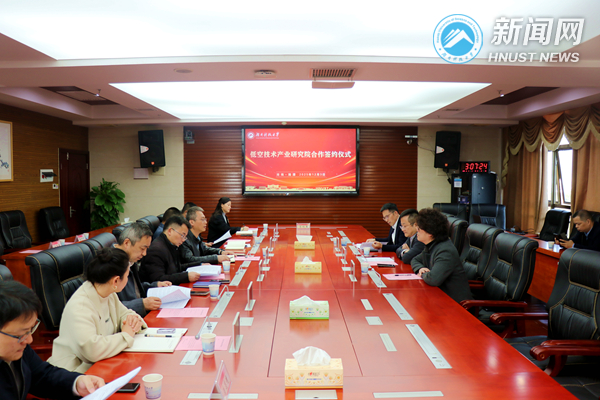
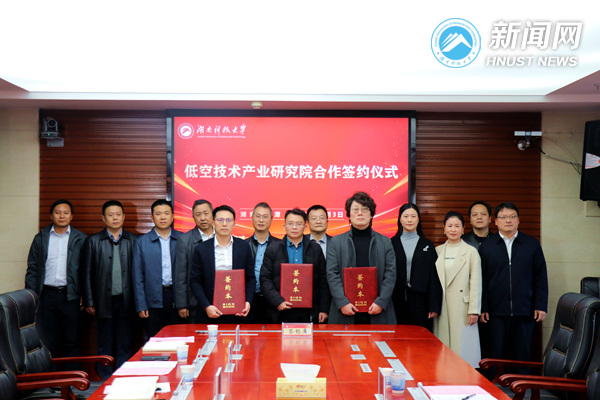
On December 3rd, HNUST held a signing ceremony with Shanghai Zhaotai Zhongfan Technology Development Co., Ltd. and Wuhan University to jointly initiate the establishment of the Industry-University-Research Institute for Low-altitude Technology. Yu Weijian, Member of the Party Committee and Vice President of HNUST, attended and witnessed the signing.
According to the agreement, the three parties will use the Institute as a collaborative innovation platform that integrates industry, academia, research, and practical application, fully utilizing their respective strengths to achieve deep integration. HNUST will consolidate its multidisciplinary resource in creative design, business management, and technology development to provide intellectual support for industrial growth. The corporate partner will contribute its industrial resources, collaborating with the universities to drive technological innovation and real-world application.
The collaboration will focus on three key areas: Firstly, in the cultural tourism sector, the parties will explore innovative experiences from low-altitude perspectives, create demonstration projects, and enrich consumer engagement scenarios. Secondly, in talent cultivation, methods such as industry mentor lectures, real-world project training, and jointly built internship bases will enable students to engage with cutting-edge industry developments, enhance practical skills, and cultivate job-ready professionals for the low-altitude economy. Thirdly, in the emergency response field, the collaboration will focus on developing low-altitude technology solutions for scenarios like disaster assessment and emergency delivery, contributing to greater efficiency in emergency response operations.
This cross-sector collaboration is a proactive response to the national strategy of developing new quality productive forces and an important exploration to overcome bottlenecks in the development of the low-altitude economy. In the future, adhering to the principles of "complementary strengths, resource sharing, collaborative innovation, and mutual development," the three parties will deepen theoretical research, the transformation of research outcomes, and talent cultivation to promote the high-quality development of the low-altitude economy and contribute to China's low-altitude industry.
(Translated by LEI Ying and WAN Chuang)